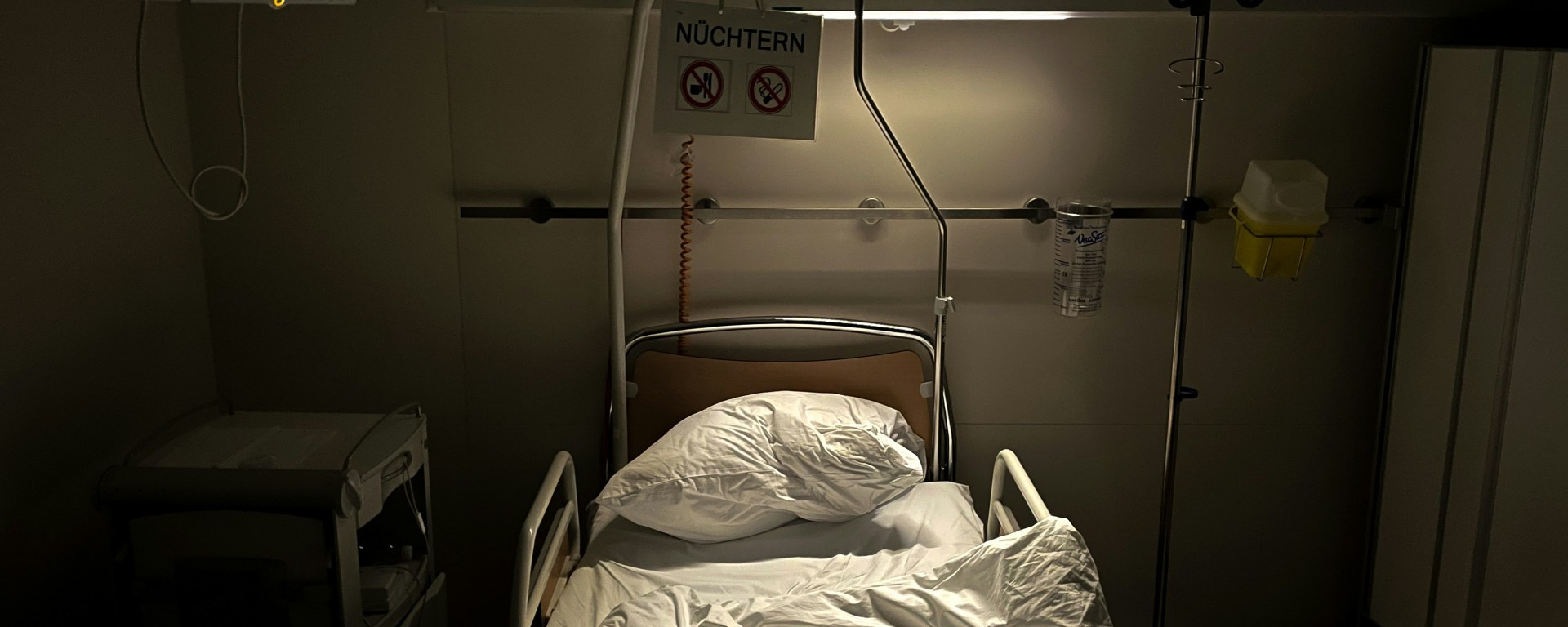
When the conversation is complete, and the patient is still lost.
Photo by Frederic Köberl on Unsplash
Anne (not her real name) asked me this in our urgent care. She was recently diagnosed with locally advanced pancreatic cancer that was deemed unresectable, and presented with vomiting and abdominal pain. She was 75 years old, lived alone, supported by an elderly sister who lived at a distance.
The fellow who was with me answered carefully. “Chemotherapy is difficult,” she said, “and there will be hard days, but we hope that as the tumor responds, you’ll feel better over time.” It wasn’t wrong. It was the right answer to a question about side effects.
But it just wasn’t the question Anne was asking.
Anne saw her oncologist for the first time a week earlier. Her oncologist disclosed that her disease was incurable, clearly explained the treatment plan (Gemcitabine and nab-paclitaxel, reasonable for her performance status), and obtained informed consent. Anne was scheduled for a port placement, a visit with a nutritionist, and one cycle of chemotherapy within a week.
But she hadn’t asked her oncologist this question a week earlier. Why? Not because he failed to create space for it. Anne simply didn’t have the question yet.
It took a week. It took nausea she hadn’t anticipated, pain she’d initially denied, nights alone with a diagnosis she was still absorbing. It took meeting someone new, someone neutral, for the question to finally have somewhere to go.
By every conventional standard, her goals-of-care conversation was documented and complete. The note existed. The disclosure happened. The consent was informed.
And she still arrived in urgent care, asking the question that should have shaped everything.
The research on prognostic awareness tells us something important here. In a longitudinal cohort study of 134 patients with advanced cancer followed over nine months, only 16% had accurate prognostic awareness, and that number barely moved over time, despite ongoing clinical contact. A separate framework describes prognostic cognition not as a straight line but as a cycle: patients can achieve awareness, lose it, and regain it. The trajectory is regulated not by information received, but by physical experience and coping capacity in that particular moment.
Anne’s question appeared because her body had begun to teach her something his words hadn’t yet reached.
This is what we miss when we treat goals-of-care as an event rather than a process. The first conversation was real and appropriate. What Anne needed was a system designed to recognize that an urgent care visit a week later is itself a clinical signal, and that the original conversation may need to find her again, in a different moment.
We have a documentation problem in medicine. Clinicians have struggled for decades to capture these conversations in language that actually reflects what happens in the room: the ambivalence, the partial understanding, the question that gets asked, and the one that doesn’t. We’ve tried structured templates, narrative notes, and goals-of-care forms. Now AI is entering the scene, promising to make it easier, and perhaps it will be.
But Anne’s case points to something deeper. It’s not that the conversation wasn’t documented; It’s that we treated it as finished.
Prognostic awareness isn’t a disclosure. It’s something that has to be cultivated, returned to, reopened, and tended over time as the patient’s body changes and their questions finally catch up to their situation. Most of us weren’t trained to do that. We’re trained to have the conversation, document it, and move forward.
Anne’s situation confirms that the body is always ahead of the record, and that the question a patient couldn’t ask at diagnosis may be waiting for the right moment, the right room, and sometimes just the right stranger.
 Marcin Chwistek, MD